Dog Clothing Size Chart: Why Breed & Market Matter | RuisPet
Why One Dog Clothing Size Chart Doesn't Fit Every Breed
When developing or buying dog clothing, one of the first things we talk about is usually the size chart.
XS, S, M, L, XL, 2XL — it looks straightforward.
But after working with pet apparel buyers in different markets, we have learned something important:
A size chart can be perfectly correct and still not be right for your market.
Why?
Because dog clothing sizing is not only about making each size a little bigger than the previous one. Different breeds have different body proportions, and different markets can have very different size demands.
Here are two real examples we have encountered while working with our customers.
Our Standard XS–2XL Range Didn't Tell the Whole Story
Many of the dog clothes we work with are designed mainly for small and medium-sized dogs.
A typical size range is:
XS / S / M / L / XL / 2XL
For many buyers, this covers the majority of their customers.
So it would be easy for a supplier to assume:
"We already have six sizes. That should be enough."
But one of our customers in Slovakia repeatedly pointed out that there was also meaningful demand for 3XL in their market.
That was interesting to us.
The existing XS–2XL size chart wasn't wrong. The issue was simply that the customer's actual market extended beyond it.
And this leads to a question that we think wholesale buyers should consider before placing an order:
What sizes actually sell in your market?
A supplier can show you a very complete-looking size chart, but your own sales data and customer profile may tell a different story.
For a retailer or distributor, adding one relevant size may sometimes be more valuable than adding several new colors.
Japan Gave Us a Completely Different Sizing Problem
Our experience with a customer in Japan was different.
Their problem couldn't be solved by simply adding a bigger size.
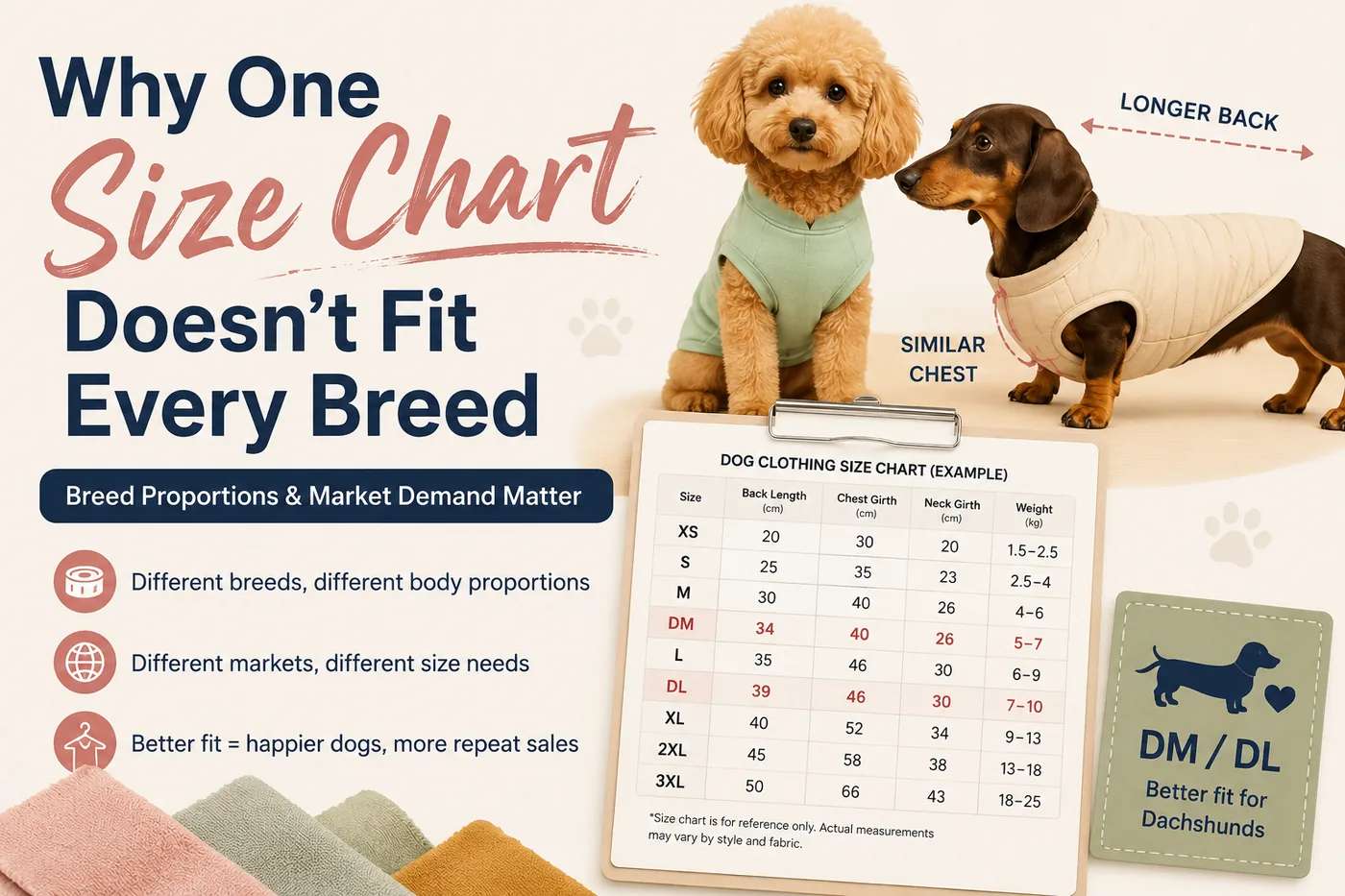
They asked us to develop two additional sizes based on our existing M and L:
DM and DL.
The reason was very specific.
They needed a better fit for Dachshunds.
Why Didn't Regular M and L Work?
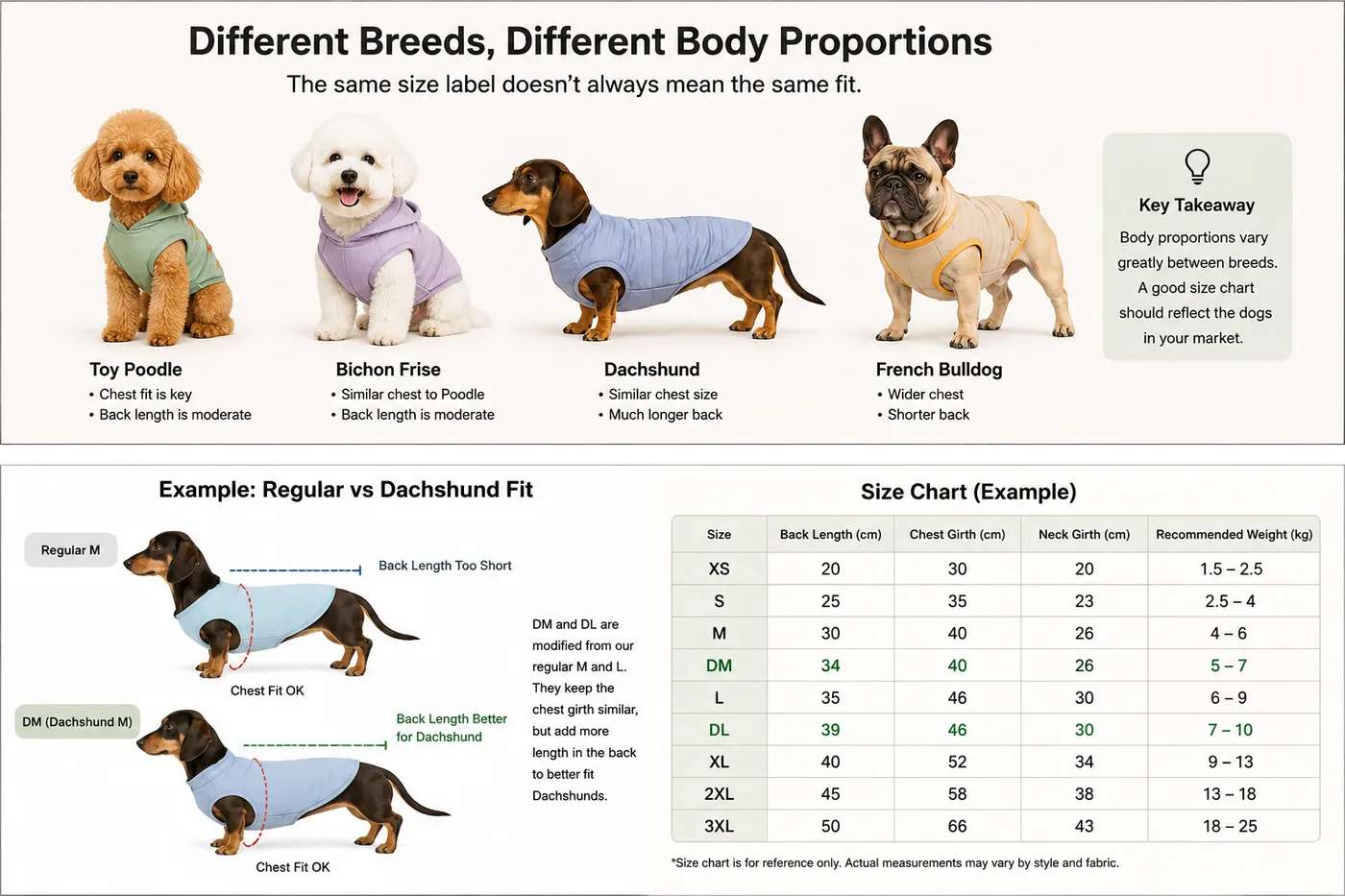
Think about the body proportions of a Dachshund compared with breeds such as a Toy Poodle or Bichon.
The chest measurement may be relatively similar.
But the Dachshund has a noticeably longer body.
This creates a problem with a conventional dog clothing size chart.
If we choose a regular size based on the chest measurement:
The chest fits → but the back can be too short.
If we simply move up one size to get more back length:
The back improves → but the chest may become too loose.
So going from M to L is not necessarily the solution.
The garment doesn't simply need to become bigger.
It needs a different proportion.
This Is Why DM and DL Were Added
For this Japanese customer's requirements, we worked from the existing M and L sizes and developed:
DM — a modified M proportion for a longer body
DL — a modified L proportion for a longer body
The important point here isn't the letters "DM" and "DL" themselves.
The important point is the thinking behind them.
Instead of scaling the whole pattern up equally, the sizing needed to respond to the dog's actual body shape.
This is something that a standard XS–2XL chart cannot always solve.
And Dachshunds are a particularly clear example of why breed proportions matter in dog apparel development.
Dog Clothing Size Is About Proportion, Not Just "Small or Large"
When people first enter the pet clothing business, it can be tempting to think about sizing in the same way we think about human clothing:
Small dog → small size.
Large dog → large size.
But dogs with similar body weight can have very different proportions.
For dog apparel, three measurements are especially useful:
Chest Girth
For many garments, chest girth is one of the most important measurements for determining fit.
If the chest is too tight, the garment can restrict movement.
If it is too loose, the garment may shift while the dog is walking.
Back Length
Back length becomes particularly important for:
Coats
Jackets
Rainwear
Full-body garments
And as our Dachshund example shows, two dogs with similar chest measurements may need very different back lengths.
Neck Circumference
The neck measurement also matters, especially for garments with fixed neck openings or closer-fitting designs.
But measurements shouldn't always be considered independently.
The relationship between chest, back and neck is what creates the overall fit.
A Bigger Size Doesn't Always Solve a Fit Problem
This is probably one of the most important lessons from breed-specific sizing.
When a garment doesn't fit, the first reaction is often:
"Let's try one size bigger."
Sometimes that works.
Sometimes it simply moves the problem somewhere else.
The Dachshund example shows this clearly.
Increasing the entire pattern to gain back length can also increase:
Chest width
Neck opening
Garment width
Other construction dimensions
The result may technically be "larger," but not necessarily better fitting.
For certain breeds, the better solution may be to modify the pattern proportions rather than simply grading the whole garment up.
This becomes especially important for pet brands that want to build collections around particular breeds or customer groups.
Market Matters Just as Much as Breed
Our Slovakia and Japan examples taught us two different lessons.
The Slovakia customer showed us a size-range issue:
The standard range needed to extend to 3XL because of actual market demand.
The Japanese customer showed us a body-proportion issue:
The existing M and L needed alternative proportions for Dachshunds.
These are different problems.
And neither one can be identified simply by asking a manufacturer:
"Do you have a size chart?"
For B2B buyers, we think the better conversation is:
Which sizes sell most in my market?
Which breeds are common among my customers?
Are there frequent fit complaints with my current products?
Do I need a broader size range, or do I actually need different body proportions?
Those answers can be much more useful when developing a collection.
What Should Wholesale Buyers Check Before Confirming Sizes?
Before ordering a new dog clothing collection, don't look only at the letters XS–2XL.
Look at the actual measurements behind them.
We recommend checking:
Chest girth
Back length
Neck circumference
Size increments between each size
Target breeds
Target market
Expected size distribution
If you already sell dog clothing, your existing sales data can be particularly valuable.
For example, if XL and 2XL constantly sell out while XS moves slowly, that information should influence your next wholesale order.
If customers repeatedly complain that a garment is too short in the back despite fitting correctly around the chest, that may indicate a proportion problem rather than a size problem.
Real customer feedback can sometimes tell you more than the size label itself.
For Custom Dog Clothing, Start With the Dog — Not the Size Label
When developing custom or private-label dog clothing, it is easy to start with:
"We need XS to 2XL."
A better starting point may be:
"Which dogs are we designing this product for?"
If the target market is mainly small companion breeds, one sizing system may work.
If Dachshunds are an important customer group, longer-body sizes may be worth considering.
If the market has meaningful demand for larger dogs, the upper end of the size range may need to be extended.
There is no universal answer.
That's exactly the point.
A good dog clothing size chart should reflect the dogs and the market the product is actually being designed for.
What We Learned at RuisPet
Our standard size range gives us a useful starting point, but working with buyers in different countries has shown us why sizing sometimes needs to go beyond a standard chart.
The request for 3XL from Slovakia was about local size demand.
The request for DM and DL from Japan was about breed-specific body proportions.
Both required us to look beyond the letters printed on a size label.
For retailers and pet brands, this is why we recommend discussing your target market and important breeds with your supplier — especially when developing a new collection.
Sometimes the right solution is another size.
Sometimes it's a different pattern.
And knowing the difference can make a much better product.
Developing Dog Clothing for a Specific Market or Breed?
If your existing size chart doesn't quite match your customers, tell us which breeds, measurements and markets you are targeting.
We can discuss whether an existing size range works or whether the pattern proportions need to be adjusted for your project.
Contact RuisPet Wear to discuss your dog clothing sizing requirements.
 Custom Dog Clothing Quote from a Photo: What Manufacturers Need
 Wholesale Dog Clothes: A Complete Buying Guide for Pet Retailers